
Governed-context thesis
Context is governed, not kept without limit.
Everything is context means that information can matter to a consequential decision only when its relevance, provenance, trust, access, retention, and disposition are governed.
How IVA governs decision-relevant context through provenance, access, retention, deletion, and explicit human authority for consequential decisions.
Context is not a data swamp. It is information whose relationship to a decision, source, permitted use, lifecycle, and accountable owner can be examined.
Canonical IVA visual / 02
Everything Is Context and the Human-AI Governance Interface
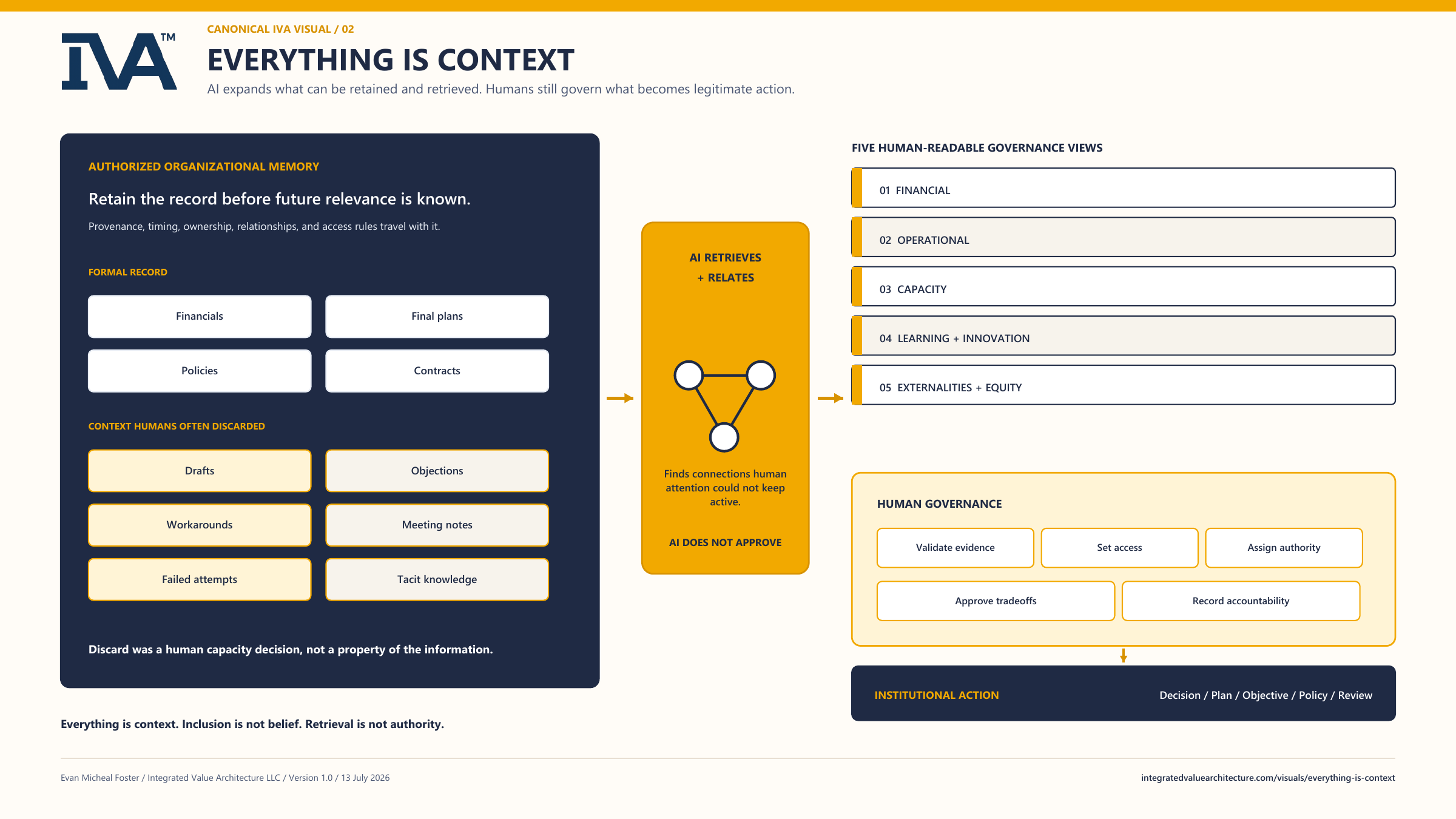
Everything is context. Inclusion is not belief, retrieval is not authority, and retention is not permanent by default. People govern what the evidence supports, who may use it, how long it remains, and what the organization is authorized to do.
Decision relevance
Context becomes useful when its relationship to a decision can be examined.
Organizations have always selected what deserved to be recorded, summarized, circulated, retained, and deleted. Storage, retrieval, privacy, security, legal duties, and attention all shape that choice. The absence of a record can hide a relevant constraint, but the possibility of relevance does not create a duty to keep everything.
Financial information survived unusually well because money provided a standardized compression system. Drafts, rejected alternatives, workarounds, objections, and tacit knowledge rarely had the same infrastructure. IVA asks whether those materials are materially relevant to a bounded decision and, if so, how their source, trust, access, retention, and eventual disposition should be governed.
Context is information whose decision relevance and provenance are managed.
Selection is structure
The formal record is the information that survived.
A budget, capacity statement, organization chart, policy, and approved plan can support a conventional feasibility analysis. They do not contain everything the organization knows. They contain what had enough authority, time, format, and legitimacy to become official.
A rejected option may document a path already tested. A workaround may be preserving delivery while hiding fragility. An objection that never reached leadership may explain why the same decision keeps failing. These records belong in the decision context only when they are relevant, lawfully held, appropriately protected, and useful enough to justify their collection and review burden.
Abandoned drafts
Show what was attempted, which assumptions failed, and which constraints blocked approval or implementation.
What people know
Reveals judgment, dependencies, relationships, workarounds, and knowledge concentrated outside formal systems.
Informal fragments
Notes, messages, and unfinished ideas show what could not justify the effort required for formal recognition.
Contradictions
Disagreement, staleness, duplication, and false claims still reveal provenance, incentives, uncertainty, or governance failure.
Governed lifecycle
Relevance, provenance, access, retention, and deletion belong in the same record.
Everything is context is a governance claim, not a command to collect or retain every available record. A governed Context Ledger identifies why an item matters to a specific decision, where it came from, how much it should be trusted, who may access it, how long it should be retained, and when it should be restricted, transferred, or deleted.
Some context should be preserved. Some should be summarized, separated, access-restricted, or excluded. Some should be deleted because retention is unlawful, unsafe, obsolete, duplicative, disproportionate, or no longer relevant. The decision record should make that lifecycle visible instead of allowing silent accumulation.
- 01
Establish relevance
Link the record to one decision, claim, constraint, alternative, commitment, or review trigger.
- 02
Preserve provenance
Record source, date, owner, trust, uncertainty, sensitivity, and the transformations applied to the information.
- 03
Control access
Separate possession from permission by defining who or which systems may view, retrieve, infer from, disclose, or act on the record.
- 04
Govern the lifecycle
Set retention, review, transfer, restriction, deletion, legal-hold, and public-record conditions appropriate to the material.
Garbage in, garbage out
More context does not excuse poor evidence discipline.
AI can relate formal records, drafts, operating traces, contradictions, and prior decisions at a scale no individual can review unaided. That capability makes provenance, relevance, data minimization, and authority more important, not less. A false statement is not accepted as truth merely because it was retained or retrieved.
A duplicate may reveal fragmentation. An obsolete draft may preserve an assumption that shaped a later decision. It may also be misleading, sensitive, or unnecessary to keep. The failure is not simply too little or too much context; it is context used without adequate provenance, permission, lifecycle control, or decision relevance.
Retrieval is not evidence. Inclusion is not authority. Retention is not permanent by default.
The human interface
AI can retrieve the larger record set. People still assign evidence, authority, access, and accountability.
The five ledgers do not limit what enters the system and they are not five storage bins. They organize financial position, operational reliability, capacity, learning, and external consequences into separate human-readable records without collapsing unlike results into one number.
AI may update and compare these records continuously. People still decide which evidence is accepted, who has authority, which uses are permitted, which tradeoffs are allowed, and who is accountable for the result.
Financial
Money, assets, liabilities, revenue, cost, restrictions, funding, and conventional financial obligations retain their established standing.
Read this page 02 / SVUoOperational
Workflow reliability, execution conditions, handoffs, rework, backlog, routing failures, continuity, and service performance.
Read this page 03 / SVUcCapacity
Labor, time, attention, role load, infrastructure, redundancy, concentration risk, resilience, and the ability to sustain the work.
Read this page 04 / SVUlLearning + innovation
Adaptation, experimentation, institutional memory, knowledge transfer, controlled change, and capability that actually improves.
Read this page 05 / SVUeExternalities + equity
External obligations, stakeholder consequence, public legitimacy, access, burden distribution, environmental effects, and exposure.
Read this pageEverything is context is not retain everything
Relevance, truth, weight, permission, retention, and authority are different questions.
- An item enters the decision context because its relevance can be stated, not merely because it exists.
- Inclusion does not make every claim true or every source reliable.
- Evidence quality, provenance, currency, uncertainty, and dissent determine weight.
- Privacy, security, law, public-record duties, policy, and legitimate authority govern access and permitted use.
- Retention and deletion are governed decisions with owners, review dates, and documented conditions.
- No record changes an institutional decision merely because a model retrieved it; decision rights and accountability remain explicit.