
Architecture overview
Retain more than the approved plan, financial report, policy, and organization chart.
IVA links evidence, authority, capacity, funding, accountability, value, burden, and decision rationale while governing provenance, access, retention, and deletion.
Integrated Value Architecture governs decision-relevant context and keeps financial, operational, capacity, learning, and external effects independently visible.
Decision-relevant context should be governed before a consequential choice is treated as ready to implement.
Canonical IVA visual / 01
The Five-Ledger Architecture
The Five-Ledger Architecture places five independent human-readable governance views over one organizational context field. No ledger may erase another before people with authority approve the tradeoff.
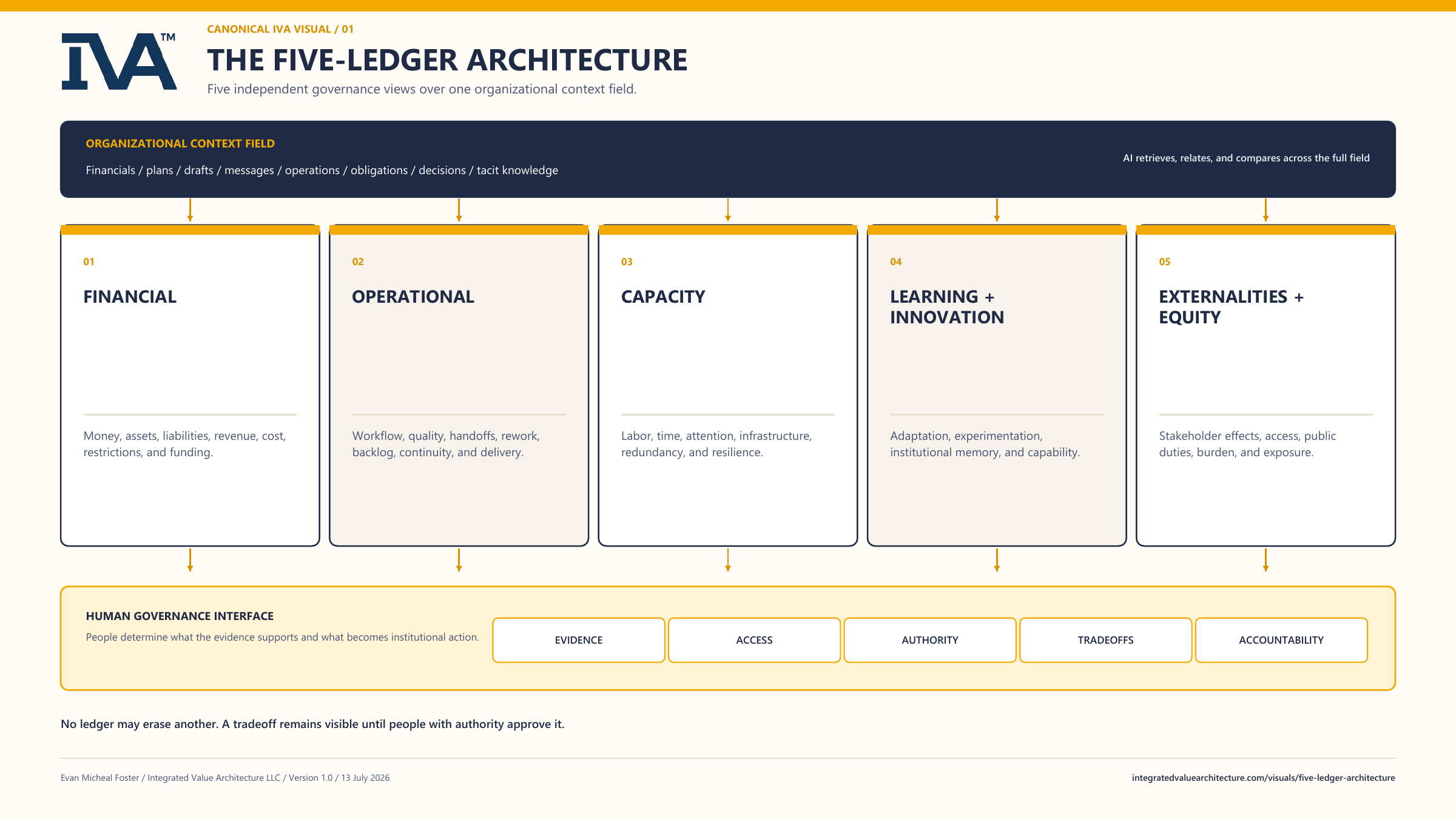
Three connected layers
Records, five ledgers, and decision rights.
- 01
Governed context
Decision-relevant records carry source, timing, ownership, trust, uncertainty, access, retention, and deletion rules.
- 02
Five-ledger governance
Financial, Operational, Capacity, Learning and Innovation, and Externalities and Equity retain independent standing instead of being forced into one dominant language.
- 03
Decision legitimacy
Evidence, authority, capacity, funding, obligations, owners, and review points determine whether an analysis can become institutional action.
The structural problem
One governing lane cannot represent the whole organization.
Organizations often rely on one internal domain to decide what counts as evidence, value, risk, and legitimate action. Finance is the most common because it already has standards, recurring records, recognized authority, and the ability to withhold approval or funding. The problem is not finance. The problem is forcing unlike realities to pass through one lane before they count.
IVA calls the broader condition Internal Governance Monopoly. It responds with independent domains, recognition requirements, ledger registers, structural events, and a non-consolidation doctrine that prevents a gain in one domain from erasing a loss in another.
Category boundary
Not a dashboard, scorecard, data lake, or consulting vocabulary.
A data platform can store information. A dashboard can summarize indicators. A scorecard can organize measures. None of those establishes which forms of value have independent standing, who owns recognition, what evidence survives review, how cross-domain effects are recorded, or when conformance must be withheld.
IVA specifies which records remain separate, how a structural position enters an authoritative ledger, who may approve it, and how a machine-supported decision is documented and reviewed.
Self-published architecture record
States IVA LLC's proposed architectural requirements, ledger independence, recognition, reporting cadence, governance roles, and conformance concepts. It is not an accredited consensus standard.
Read this pageProtected methods
Calibration, scoring interpretation, diagnostic sequencing, evidence templates, audit instruments, and implementation playbooks remain separate.
Applied interfaces
The Decision Passport, Decision Readiness, Value-Based Objectives, and Rule 52 translate the architecture into bounded operating records.
Read this pageThe five domains
Five independent views over one contextual field.
The ledgers are governance domains, not storage partitions. The same event can affect several ledgers, but each effect is recognized independently. Cross-ledger visibility is required; cross-ledger conversion and netting are prohibited.
Financial
Money, assets, liabilities, revenue, cost, restrictions, funding, and conventional financial obligations retain their established standing.
Read this page 02 / SVUoOperational
Workflow reliability, execution conditions, handoffs, rework, backlog, routing failures, continuity, and service performance.
Read this page 03 / SVUcCapacity
Labor, time, attention, role load, infrastructure, redundancy, concentration risk, resilience, and the ability to sustain the work.
Read this page 04 / SVUlLearning + innovation
Adaptation, experimentation, institutional memory, knowledge transfer, controlled change, and capability that actually improves.
Read this page 05 / SVUeExternalities + equity
External obligations, stakeholder consequence, public legitimacy, access, burden distribution, environmental effects, and exposure.
Read this page