Five-ledger architecture
Five governance views. One organizational context field.
The ledgers are not five scorecards or databases. They are independent domains that let humans govern unlike forms of value while AI reasons across the larger context connecting them.
The five IVA ledgers give Financial, Operational, Capacity, Learning and Innovation, and Externalities and Equity value independent standing without consolidation.
Every ledger can look healthy while another is failing. That is why none may erase another.
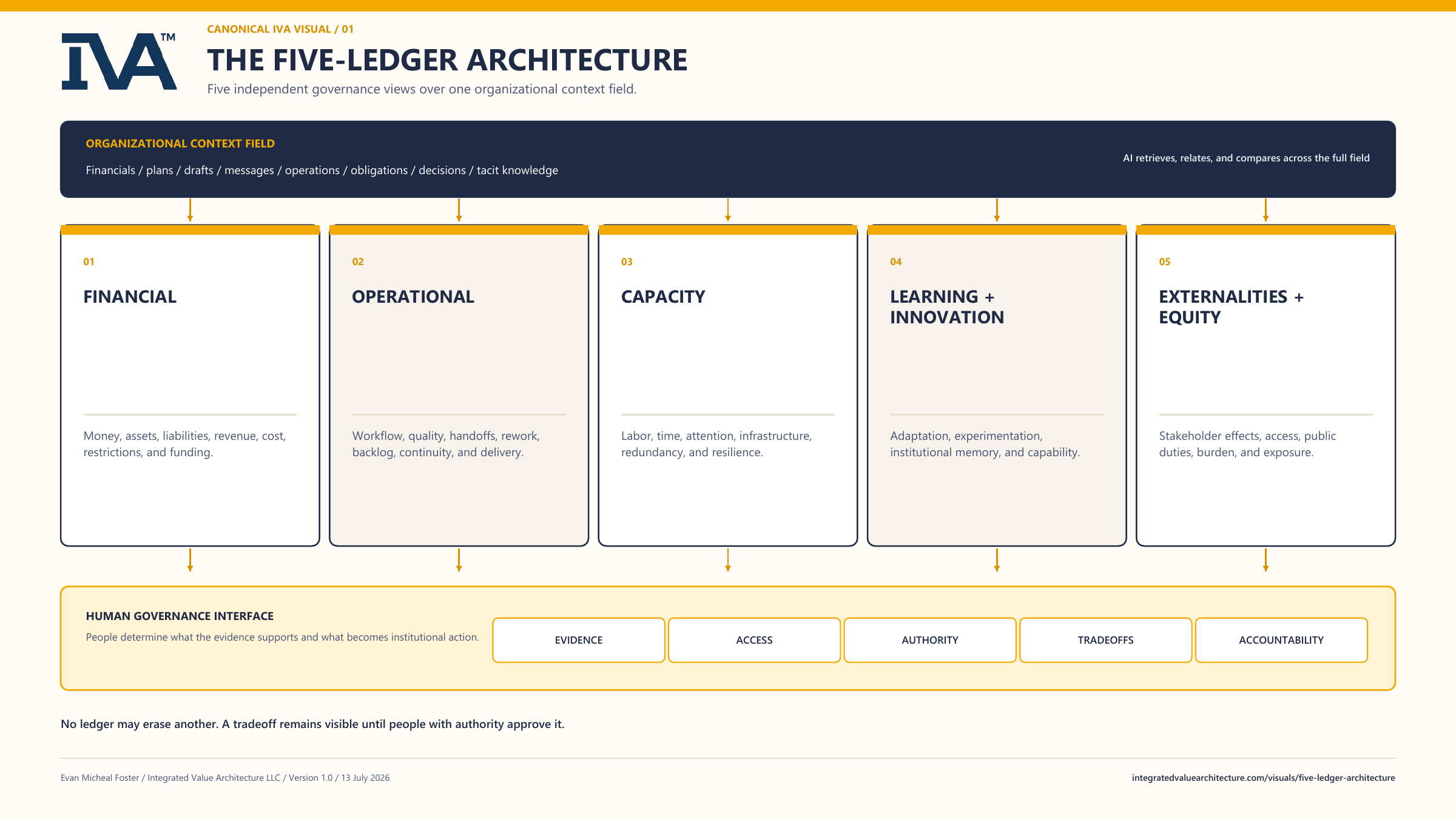
Canonical IVA visual / 01
The Five-Ledger Architecture
The Five-Ledger Architecture places five independent human-readable governance views over one organizational context field. No ledger may erase another before people with authority approve the tradeoff.
Independent standing
What each ledger sees.
Financial
Money, assets, liabilities, revenue, cost, restrictions, funding, and conventional financial obligations retain their established standing.
Read this page 02 / SVUoOperational
Workflow reliability, execution conditions, handoffs, rework, backlog, routing failures, continuity, and service performance.
Read this page 03 / SVUcCapacity
Labor, time, attention, role load, infrastructure, redundancy, concentration risk, resilience, and the ability to sustain the work.
Read this page 04 / SVUlLearning + innovation
Adaptation, experimentation, institutional memory, knowledge transfer, controlled change, and capability that actually improves.
Read this page 05 / SVUeExternalities + equity
External obligations, stakeholder consequence, public legitimacy, access, burden distribution, environmental effects, and exposure.
Read this pageCross-ledger visibility
One event can create five different positions.
A decision to expand may increase expected revenue, depend on a fragile workflow, exceed current capacity, require learning the organization has not built, and shift burden onto customers or communities. AI can connect all of those effects. IVA requires the human governance layer to preserve each one in its native domain.
The point is not to stop tradeoffs. It is to prevent a dominant ledger from erasing the tradeoff before leaders make it.
Why ledgers remain
AI does not need simplified bins. Institutions still need understandable accountability.
The five ledgers are a translation and governance layer. Boards, executives, regulators, auditors, staff, and the public need to understand what evidence mattered, which domain changed, who had authority, what tradeoff was accepted, and who remains accountable. The ledger view keeps machine-supported reasoning inspectable without forcing the underlying information field back into human cognitive limits.